Halifax River Lots, Reed Canal and Flood Zones
The city is laced with water. The Halifax River, Reed Canal, Halifax Canal, Stevens Canal, Bellwood Waterway and Reef Waterway all meet the city boundary. FEMA's flood layer puts about 40% of the land in Zone X with a 0.2 percent annual chance, 37% in plain Zone X, 14% in Zone AE and 9% in Zone A. Where AE applies, base flood elevations are 6 to 7 ft. New structures and additions need a signed and sealed survey, plus an elevation certificate in a FEMA special flood hazard area, and the code requires flood damage-resistant materials and raised mechanical systems on small accessory structures.
The state's under-$7,500 exemption (HB 803, effective July 1, 2026) won't help you in those zones. The city's Permit Exemption Policy bars property partly or entirely in a flood hazard area, plus electrical, plumbing, structural, mechanical or gas work. You make the request in writing and include the contract. The code adds that retaining walls, and sidewalks and driveways that involve fill in regulated floodways, must meet floodway limits.
An October 2026 update says the city is running stormwater system improvements in residential neighborhoods to better manage flooding events. Look at that page before you plan a pour near a street project. As concrete contractors in South Daytona, we schedule around it.
What Poorly Drained Soil Does to a South Daytona Slab
NRCS soil mapping puts Tuscawilla-Urban land on about 40% of the city's land. It's poorly drained and rated very limited for dwellings without basements. Daytona-Urban land, moderately well drained, covers around 14%, and Immokalee sand, Tuscawilla fine sand and Turnbull variant sand each add about 9%. All told, roughly 63% of the land is rated very limited for dwellings.
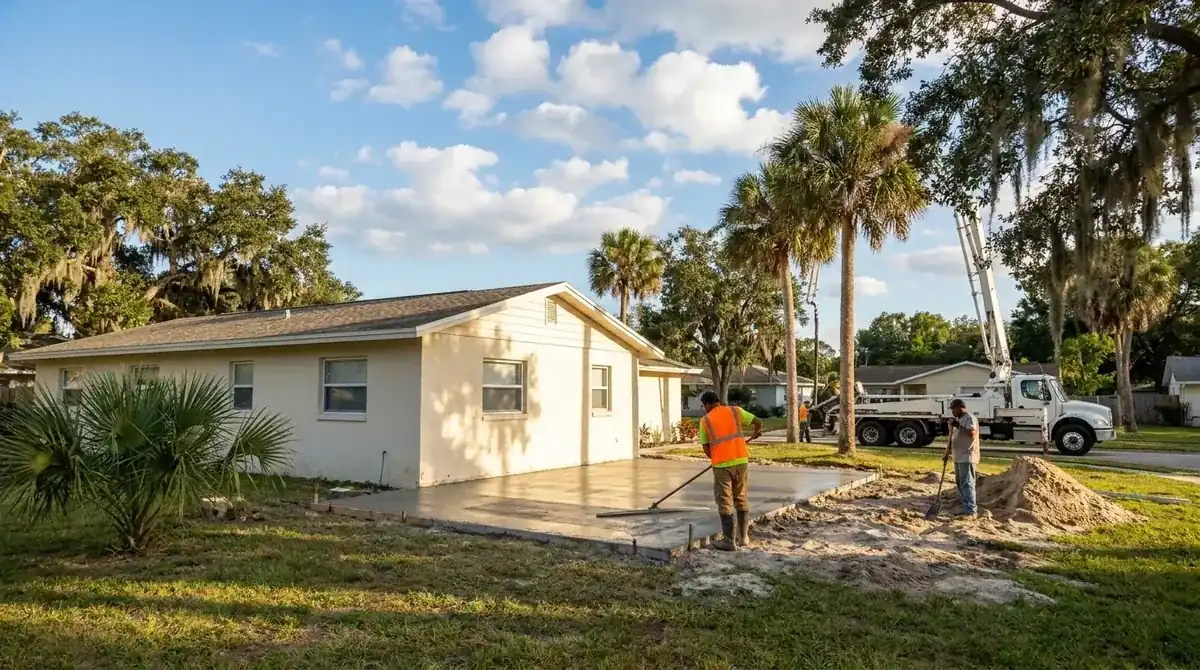
After a heavy rain on poorly drained ground, the water table sits close to the surface. Under a slab, the base matters more than the top. We strip organics, compact the sand and set the slope so water leaves the slab. The Florida Geological Survey says buried organic debris and poorly compacted fill can cause depressions that mimic sinkholes. That's the reason we never skip compaction. Trees matter too. Removing any tree 6 inches across or larger needs a city permit, mangroves of any size are protected, and UF/IFAS notes that live oak roots can lift concrete.
Thinking about a patio? The patio page for the city covers lot lines and drainage for that job, and the stamped concrete page covers finishes. As concrete contractors in South Daytona, we also serve Daytona Beach, so one call covers both sides of the city line.