Serving Port Orange & Volusia County  |  Call Now: (386) 220-8770
📞 (386) 220-8770
★★★★★ 5.0 Google Rated · Verified Reviews
Fully Insured
Free Estimates
Locally Owned — Volusia County
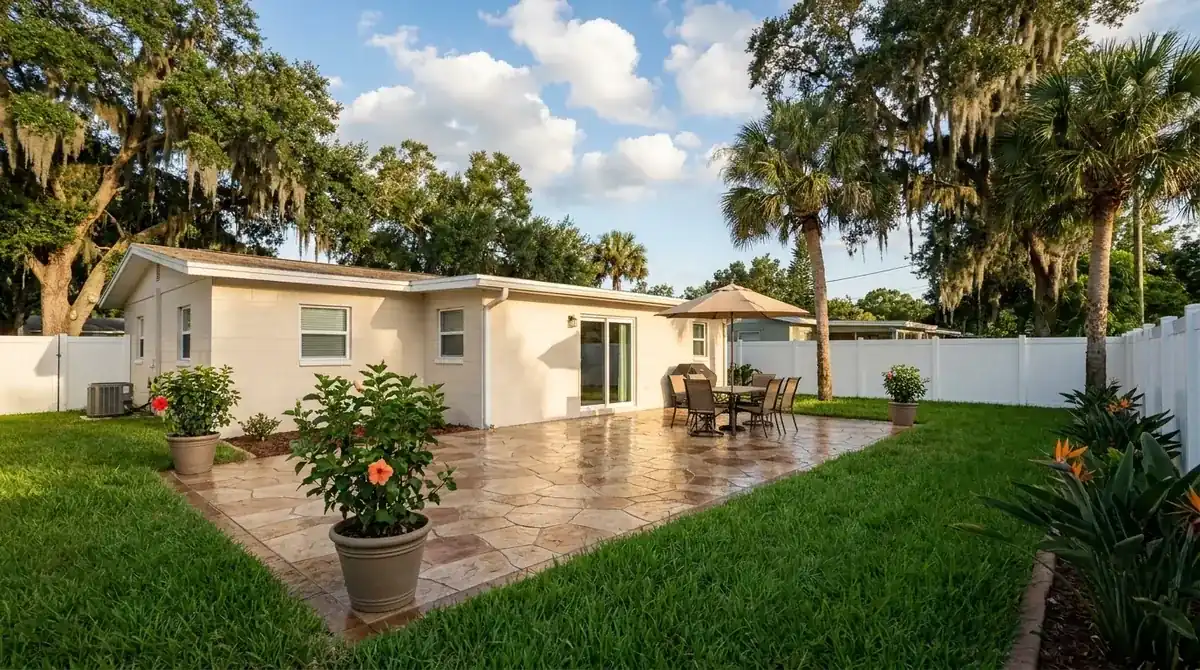
Stamped concrete patio in warm stone tones with potted flowers and a white fence, stamped concrete in Volusia County
Homeowner Guide

Stamped Concrete vs Pavers in Volusia County

Straight talk on heat, slip, upkeep, repairs and right-of-way rules for patios, walkways and driveways.

Fully Insured
Free Quotes
5-Star Google Rated

Quick answer

Stamped concrete vs pavers comes down to upkeep, repairs and the rules at your curb. Port Orange Concrete Co pours stamped work at $12 to $20 per sq ft in Volusia County. Stamped needs sealer and joints. Pavers need joint sand and weed control. Both trigger the same county right-of-way paperwork. Here's how to choose.

Stamped concrete vs pavers in Volusia: the short answer

Think of a stamped surface as one poured slab with a pattern and color pressed in. Pavers are separate units on a compacted base, with sand in the joints. Either one looks good in Volusia. Neither is cheap to redo. So you're really choosing on upkeep, repairs and the rules at your curb. Our stamped slabs run $12 to $20 per sq ft, which puts a typical 300 to 500 sq ft patio at $3,600 to $10,000. We don't publish a paver price here, and we won't make one up.

We can tell you how each one behaves on this ground and under these codes. Pavers want joint sand and weed control. A stamped slab wants sealer and joints, and once it cracks, it stays cracked. In the right-of-way, both kinds of apron trigger the same county paperwork. Read on, then pick what fits how you use the space.

Hot feet and wet feet: heat and slip on each surface

July is the hottest month in Daytona Beach, and NOAA's 1991 to 2020 normals put the average high at 90.2 degrees. Surface temperature is a different number. EPA says pavements run cooler when they reflect more solar energy or let water evaporate. So color and finish matter as much as the material. Get a sample, stamped color or paver, and leave it out in the sun.

Slip is the second test. Concrete Network, a trade source that leans toward stamped work, says a textured stamped surface is often more slip resistant than a plain pour, but it can turn slippery when wet or under a film-forming sealer. A heavier texture or a non-skid additive helps near entries. Before any stamped patio or walk gets poured, we sit down and settle sealer type and texture.
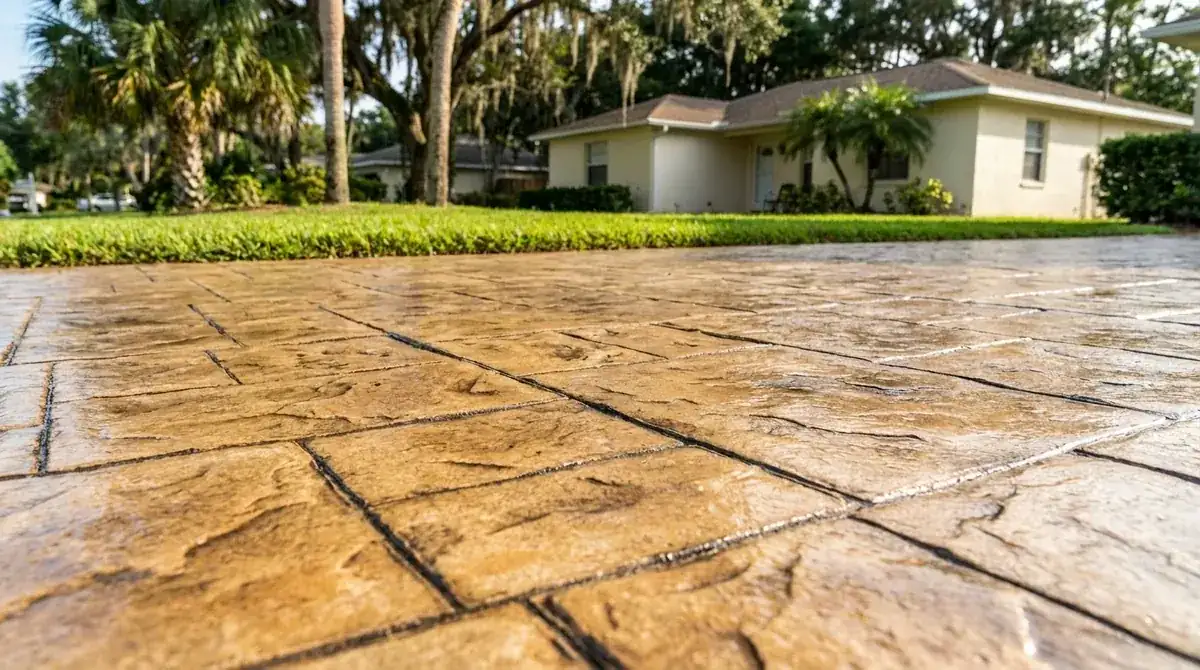
Low view of ashlar-pattern stamped concrete in front of a home, stamped concrete in Volusia County

Sealer, joint sand and weeds: the upkeep each one asks for

A stamped surface has to be sealed. Concrete Network notes that contractors usually seal it to guard against wear and abrasion, and the IRMCA homeowner sheet puts the first sealer about 30 days after placement. Re-seal when the shine fades. And a sealed surface needs a traction plan.

Pavers swap the sealer job for a joint job. The same trade source says weeds have to stay out of the joints and the joints have to stay full of sand. After a rainy Florida summer, that's a seasonal chore. In Daytona Beach's parkage, the owner maintains and replaces any pavers. NOAA's normals make September (7.15 inches), June (6.94), August (6.58) and July (6.01) the city's wettest months. All that water has to go somewhere, so plan drainage first for either surface.

Neither one is maintenance free, so stamped concrete vs pavers is a question of which chore you'd rather do. Ask each bidder what the first three years look like, then compare.

Cracks, settling and repairs: what goes wrong and how you fix it

Even a well-poured slab cracks. The building code calls for contraction joints in a slab on ground unless fibers or welded wire hold the cracking down, and we cut joints to steer cracks where you won't notice them. We can't promise a slab never cracks, and a stamped pattern doesn't change that. A crack is harder to hide in a colored, patterned surface than in a plain gray slab.

Pavers fail differently. They ride on a compacted base, and a soft spot under them shows up as a dip. The Florida Geological Survey says poorly compacted fill can create depressions that look like sinkholes. Either surface is won or lost in the base work. Flatwoods soils such as Myakka, Smyrna and Immokalee hold a seasonal high water table, while ridge sands drain fast. Fixing a paver surface means lifting and resetting the affected units. Fixing a slab means cutting out and replacing a section, which is a tear-out and a pour.

UF/IFAS says live oak roots lift both. Keep the pour or the base clear of big roots, or plan around them.

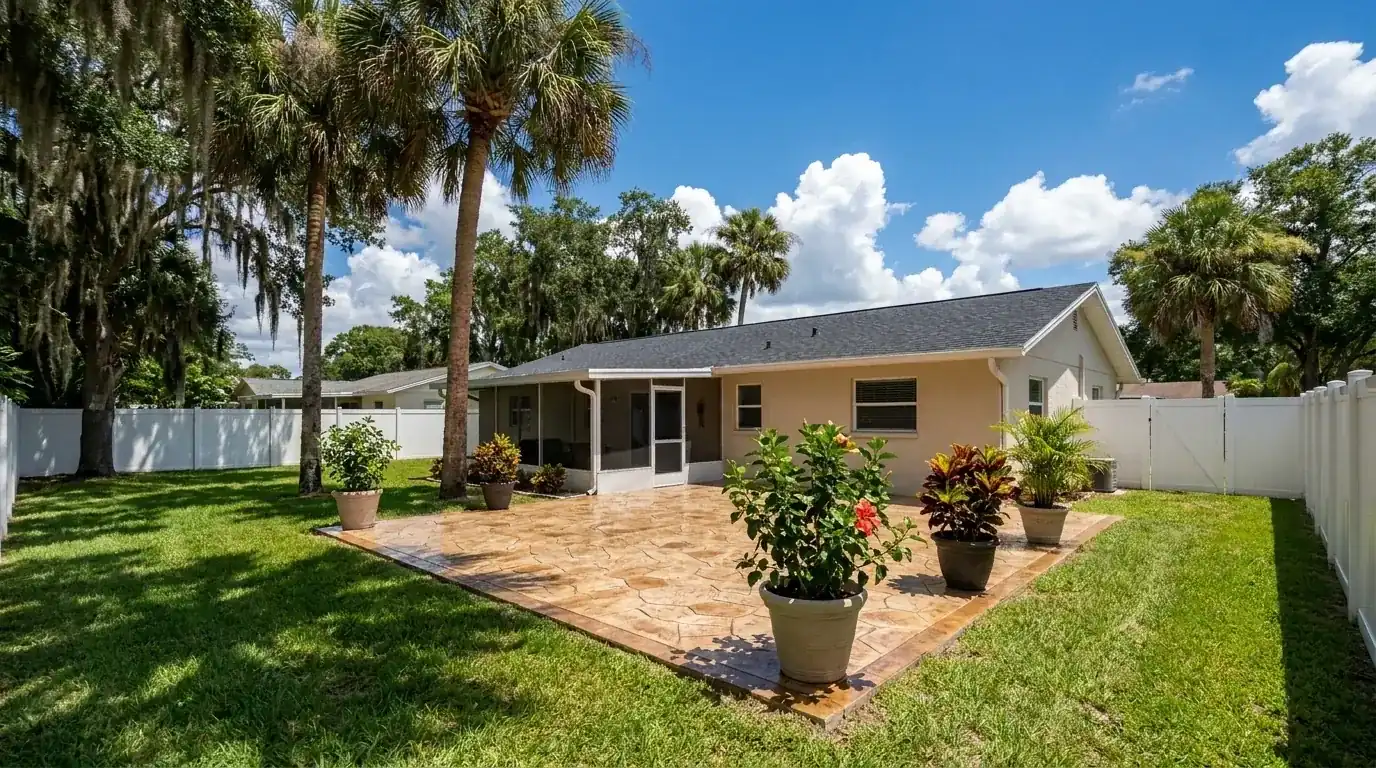
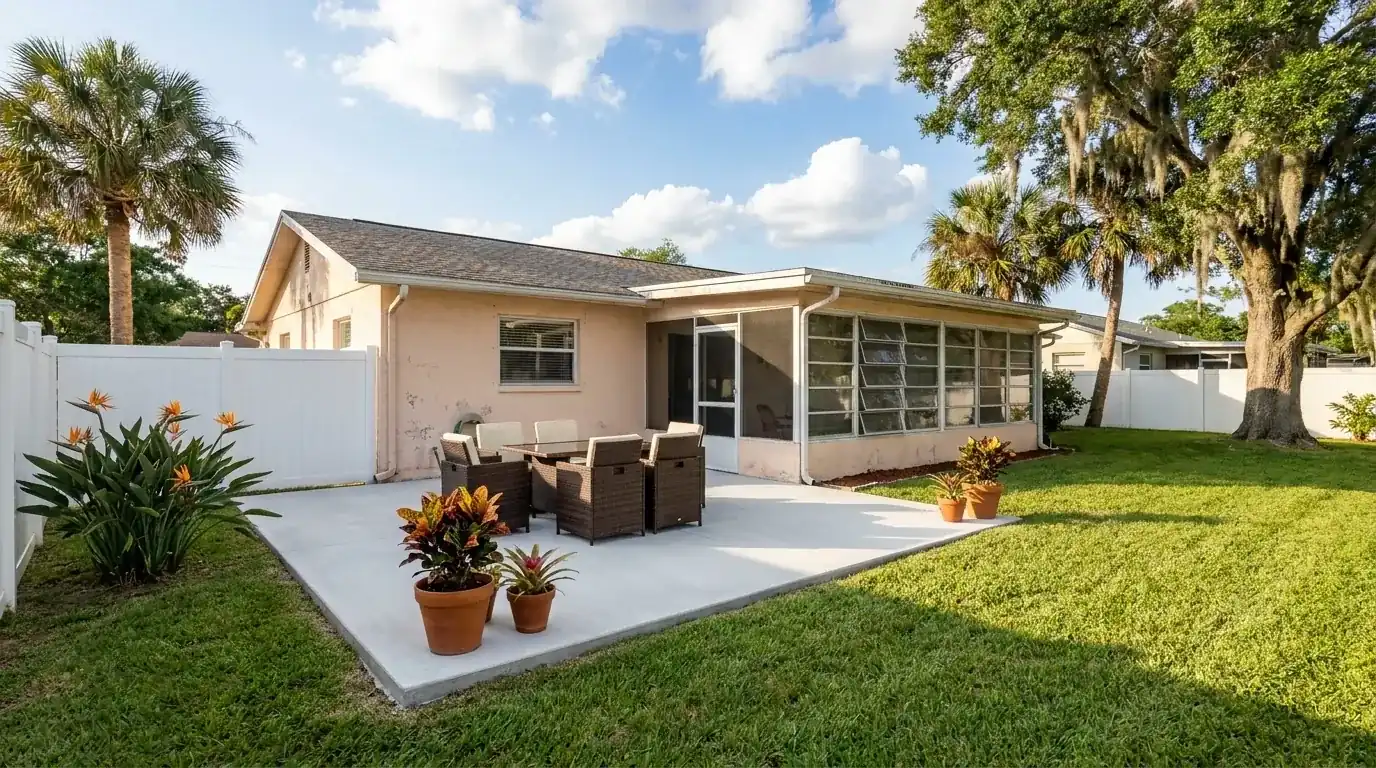
Concrete patio with wicker seating beside a screened porch and white fence, stamped concrete in Volusia County

Right-of-way and code rules that hit both surfaces alike

County rules lump the two together. In unincorporated Volusia, a paver driveway apron or stamped concrete in the right-of-way takes a notarized Hold Harmless. The owner signs it, not an agent, and it's recorded with the Clerk. A paver apron also takes the county's Paver Detail Sheet and a contractor with a Volusia County Competency Card. A plain poured apron in that same right-of-way skips the Hold Harmless. The Volusia County concrete permits guide has the full desk-by-desk list.

Cities pile on their own. Daytona Beach requires a recorded license agreement for pavers in the parkage, plus two business days' notice before excavation. For pavers in the Flagler Beach right-of-way, the city wants an original Right of Way Utilization Agreement signed by everyone on the deed. Port Orange caps front-yard driveway and parking coverage at 40 percent and counts pervious surfaces such as pavers in that total. It can also require pervious surfaces like turf-block in a tree's dripline. Ponce Inlet allows pavers in parking areas, and pervious surfaces such as turf block with a maintenance plan. New Smyrna Beach bars pavers seaward of its coastal setback line without a variance.

Find out your lot's rule before you settle stamped concrete vs pavers on looks. The beachside slab guide covers the coastal ones.

Patio, walkway or driveway: where each surface fits

Patios. Both work. A stamped patio is one clean surface with a pattern and a color, and plain patios at $8 to $14 per sq ft set the baseline. Pavers give you a modular look plus a joint line to look after. A flood-zone patio close to the water? Ask first. The code may require a frangible slab.

Walkways. A poured sidewalk runs $8 to $13 per sq ft, and stamping adds pattern. Pavers earn their keep where a path has to wind around roots. A few units lift and reset. Where a sidewalk crosses a county right-of-way, the county's 1.5 percent cross slope applies either way.

Driveways. A driveway carries vehicles, so thickness, base and joints count for more than looks. Our driveways run $7 to $12 per sq ft, and stamping runs $12 to $20. Concrete Network says stamping works on a driveway but takes more engineering than a patio: adequate thickness, reinforcement, a compacted subbase and correctly spaced joints. Our driveway cost guide shows the math.

Questions to settle before you ask for bids

Work through this list, then call:

  • Who maintains it? Won't re-sand joints? Stamping suits you better. Won't re-seal? Go with plain broom finish.
  • Where does the water go? Name the low spot and the downspout before the base is built.
  • Is any of it in the right-of-way? Depending on the city, that means the Hold Harmless, the license agreement or the utilization agreement.
  • Does your HOA have a say? F.S. 720.3035 limits an association to what its declaration grants, and it can't make you pull a government permit first.
  • Is the lot in a flood zone or near the coast? That can change the slab design.
  • What's your budget range? Our range for stamping is $12 to $20 per sq ft, so a 400 sq ft patio is $4,800 to $8,000.

Bring your answers to the free written estimate and we'll weigh stamped concrete vs pavers for your lot and price the stamped side. Ask for yours.

Stamped tile-pattern concrete patio with a table and umbrella behind a house, stamped concrete in Volusia County

Frequently Asked Questions

Is stamped concrete vs pavers cheaper in Volusia County?
Our stamping is $12 to $20 per sq ft, and plain patios are $8 to $14. A paver price isn't something we publish, and a made-up number wouldn't help you compare. Get paver bids in writing. Count the tear-out, base and sand work in each one. Our free written estimate takes care of our side.
Does a paver or a stamped slab get hotter in Florida sun?
Neither stays cool on its own. EPA says pavements stay cooler when they reflect more solar energy or let water evaporate, so color and finish make the difference. Daytona Beach's July average high is 90.2 degrees. Before you commit, set a sample of each color in your yard at midday and lay a hand on it.
Is a stamped surface slippery when wet?
It can be. Concrete Network says a textured stamped surface is often more slip resistant than a plain pour, yet it can turn slippery when wet or under a film-forming sealer. Near entries, a heavier texture or a non-skid additive helps. Show us where the surface meets a door or steps, and we'll choose the texture.
Do I need a permit to put pavers or a stamped patio in my yard in Port Orange?
Port Orange's permit flyer lists a paver patio or driveway as permit work, along with a poured driveway or walkway. On exterior permits the city's site plan rules also ask for patio and driveway materials and their distances to lot lines. Confirm your patio with the Building Division before you order.
What paperwork does a paver apron on a county road need?
Four things. Volusia County wants a Use Permit from Development Engineering, a Paver Detail Sheet, a contractor with a Volusia County Competency Card, and a notarized Hold Harmless that the owner signs and the Clerk records. A stamped apron in the county right-of-way takes the same Hold Harmless. Plain aprons don't need that recorded release.
Can pavers or stamping go in a Daytona Beach parkage?
Pavers can, with a recorded license agreement. Daytona Beach lets owners of single-family, duplex and triplex lots put pavers in the parkage under a non-communications facilities permit. After that, the owner maintains and replaces them and restores the right-of-way if the city asks. Technical Services needs two business days' notice before anyone excavates.
Which one is easier to repair after a tree root or settling?
Pavers, in the sense that you lift and reset the affected units. With a slab you cut out a section, replace it and then match the pattern and color. UF/IFAS warns that live oak roots near a driveway can lift and crack the surface, so size up the root zone whichever you pick.
Should I seal stamped concrete, and when?
Yes. Contractors seal stamped work to protect it from wear and abrasion, and the IRMCA homeowner sheet puts the first sealer about 30 days after placement. A film-forming sealer can leave the surface slick when wet, so pick one with traction in mind. Re-seal when the surface goes dull.

Get Your Free Port Orange Estimate

Tell us about your project and we'll get back to you within 24 hours with a detailed, no-obligation quote.

  • 100% free, no-obligation estimates
  • Response within 24 hours
  • Insured and locally owned
  • Transparent pricing — no hidden fees
  • Volusia County concrete experience

Stamped or plain? Get a number.

Tell us the space, the surface you're leaning toward and whether it touches the right-of-way. We'll talk through stamped concrete vs pavers for your lot and put a stamped price in a free written estimate. Call (386) 220-8770 or use the form.

📞 Call (386) 220-8770 Request Quote Online
📞 Call Now Get Quote
Free Quote