
Pole Barn, Barndominium & Metal Building Slabs in Port Orange, FL
Engineered concrete slabs and foundations for pole barns, barndominiums, and steel buildings — reinforced for heavy loads. Free on-site estimates across Volusia County.
Get Your Free Port Orange Estimate
Tell us about your project and we'll get back to you within 24 hours with a detailed, no-obligation quote.
- 100% free, no-obligation estimates
- Response within 24 hours
- Insured and locally owned
- Transparent pricing — no hidden fees
- Volusia County concrete experience
Searching for “pole barn barndominium concrete slabs near me” in Port Orange? You're in the right place. Port Orange Concrete Co provides pole barn & barndominium slabs across Port Orange and all of Volusia County, FL — 40+ years of local experience, fully insured, with free estimates.
Pole Barn, Barndominium & Metal Building Slabs in Port Orange, FL
Port Orange Concrete Co pours the concrete slabs and foundations that pole barns, barndominiums, metal buildings, equipment pads, and workshops are built on. With 40+ years of experience across Volusia County, our crew delivers flat, properly reinforced, code-conscious slabs engineered for the heavy loads and large clear-span structures these projects demand. We work with homeowners, farmers, ranchers, post-frame kit suppliers, and general contractors throughout the Port Orange area.
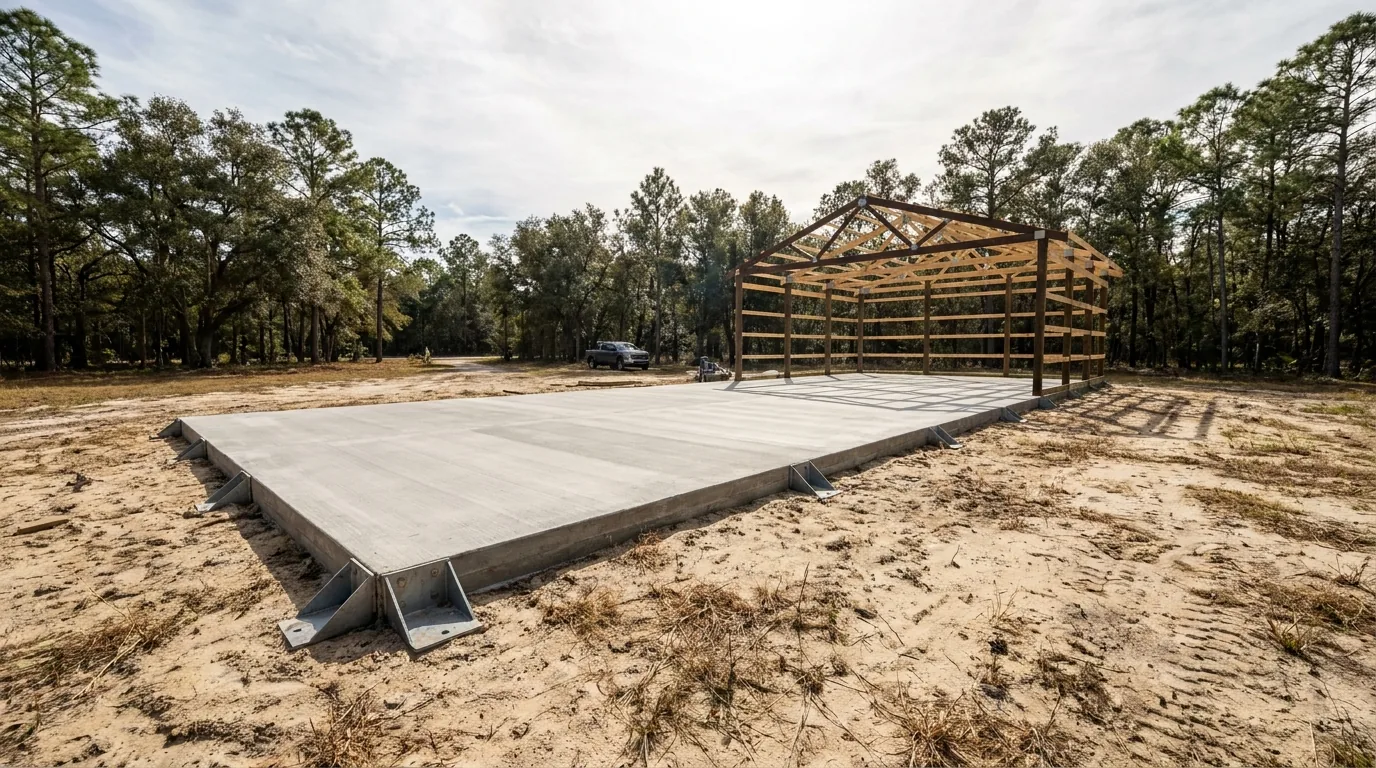
Important — what we do and don't do: we are a concrete contractor. We pour the slab and foundation; we do not erect the building itself. Once our concrete is poured, cured, and inspection-ready, you or your post-frame/steel-building crew set the posts, columns, and trusses and finish the structure. Getting the concrete right first is the single most important step — every post bracket, anchor bolt, and column base has to be set exactly to your building plan, because moving them after the pour means breaking concrete. That's why so many builders hand the foundation work to a dedicated slab crew.
Why the Concrete Under a Pole Barn or Barndominium Matters
A pole barn slab, barndominium foundation, or metal building slab isn't just a floor — it's the structural base that ties the whole building together and carries everything inside it: trucks, tractors, lifts, RVs, machinery, livestock equipment, and in the case of a barndominium, the finished living space. A poorly prepped slab cracks, heaves, and settles, and once that happens under a finished steel or post-frame building, the fix is enormously expensive. The region's sandy and clay-rich soils, combined with the local climate and a high water table where present, make sub-base preparation and reinforcement non-negotiable. We build the foundation to outlast the building on top of it.
Slab Types: Monolithic vs. Thickened-Edge/Floating vs. Perimeter Footing + Slab
There's no single "right" slab — the correct type depends on your building size, soil, frost considerations, and how the structure transfers load to the ground. The three approaches we pour most often:
- Monolithic slab. The floor and the perimeter footing are poured at the same time in one continuous pour, with the edges thickened and deepened to form an integral footing. It's fast, cost-effective, and ideal for most pole barns, shops, and many barndominiums on stable, well-drained ground. Fewer cold joints means fewer weak points.
- Thickened-edge (floating) slab. A slab with a beefed-up, deepened perimeter and reinforced thickened lines beneath load-bearing walls and post locations, designed to "float" as a single stiff plate over the sub-base. This is a workhorse for metal buildings and steel-building slabs where column loads concentrate at specific points — we thicken the concrete and add steel exactly where the building plan puts its load.
- Perimeter footing + slab (stem wall / separate footing). Footings are poured first below grade, then the slab is poured inside. This costs more and takes longer but gives better access for inspection, works well on poorer or sloping soils, and is sometimes required for larger barndominiums and in certain flood or frost conditions. It also raises the finished floor and can decouple the slab from the foundation walls.
During your free estimate we'll walk the site, look at your building plan, and recommend the slab type that matches your structure and budget — not just the one that's easiest to pour.
Thickness, PSI & Reinforcement for Large Clear-Span Buildings
Clear-span pole barns and metal buildings concentrate enormous loads on a relatively thin slab, so thickness and steel matter more than they do on a residential patio. Our typical specs:
- Thickness: 4 inches for light storage and standard shops; 5 to 6 inches (or more) for slabs that carry trucks, RVs, tractors, forklifts, vehicle lifts, or heavy equipment. We thicken the slab under post locations, column bases, and load-bearing interior lines.
- Strength: 4,000 PSI concrete as our standard, with higher mixes available where an engineer or heavy point loads call for it.
- Reinforcement: rebar on a grid (commonly #4 bar on 16-to-24-inch centers) for heavy-load and large clear-span buildings, or fiber mesh / welded-wire for lighter shop and storage slabs. Fiber mesh helps control surface cracking; rebar carries real structural load — for equipment and vehicle slabs we lean on rebar, often with both.
- Thickened edges & lines: deepened, reinforced concrete under the perimeter, under post brackets and column bases, and under any load-bearing interior walls in a barndominium.
Anchor Bolts, Post Brackets & Column Bases — Set to the Building Plan
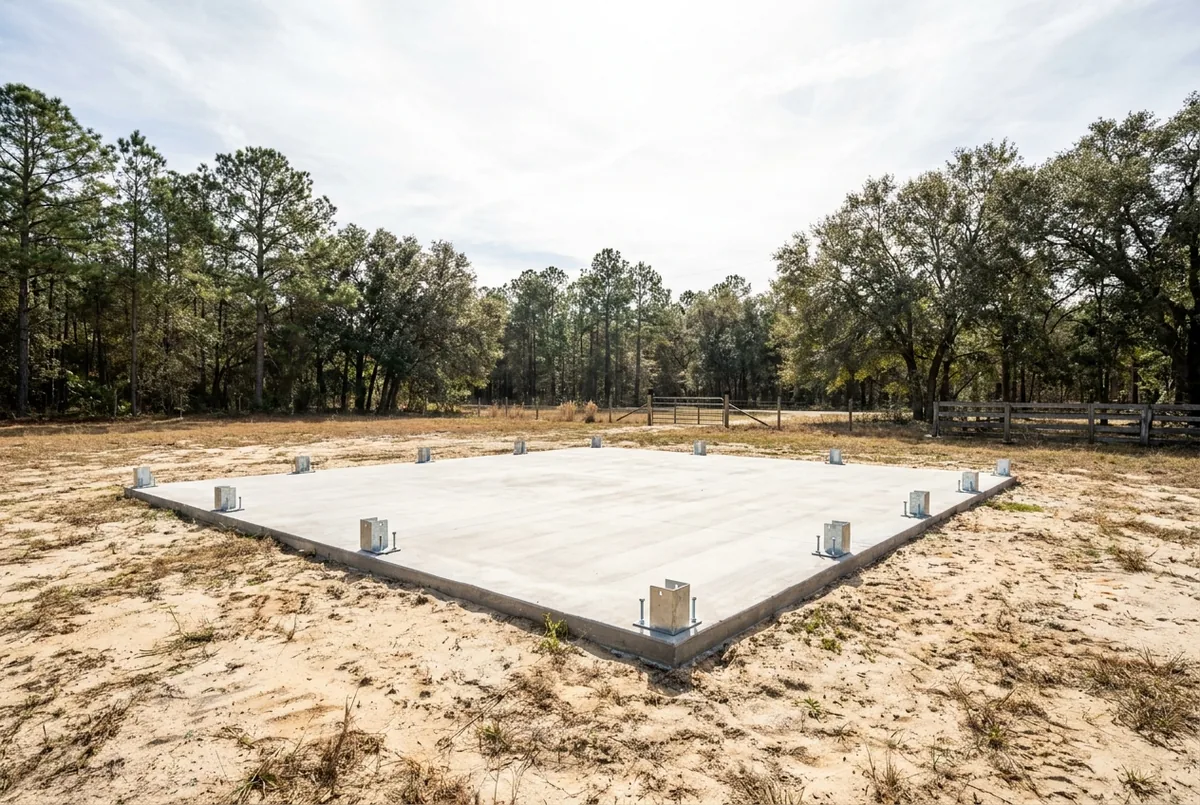
This is where slab work for pole barns and metal buildings gets specialized. Steel buildings and post-frame kits ship with a precise anchor-bolt or bracket pattern, and column bases have to land within a fraction of an inch of plan. We set anchor bolts, post brackets, and column base plates into the wet concrete (or wet-set/templated) according to your building's plan and the manufacturer's drawings, so when your steel or trusses arrive, everything lines up. We coordinate directly with you or your building supplier on the layout before the pour — because once the concrete sets, those embeds are permanent.
Vapor Barriers & Sub-Base Prep
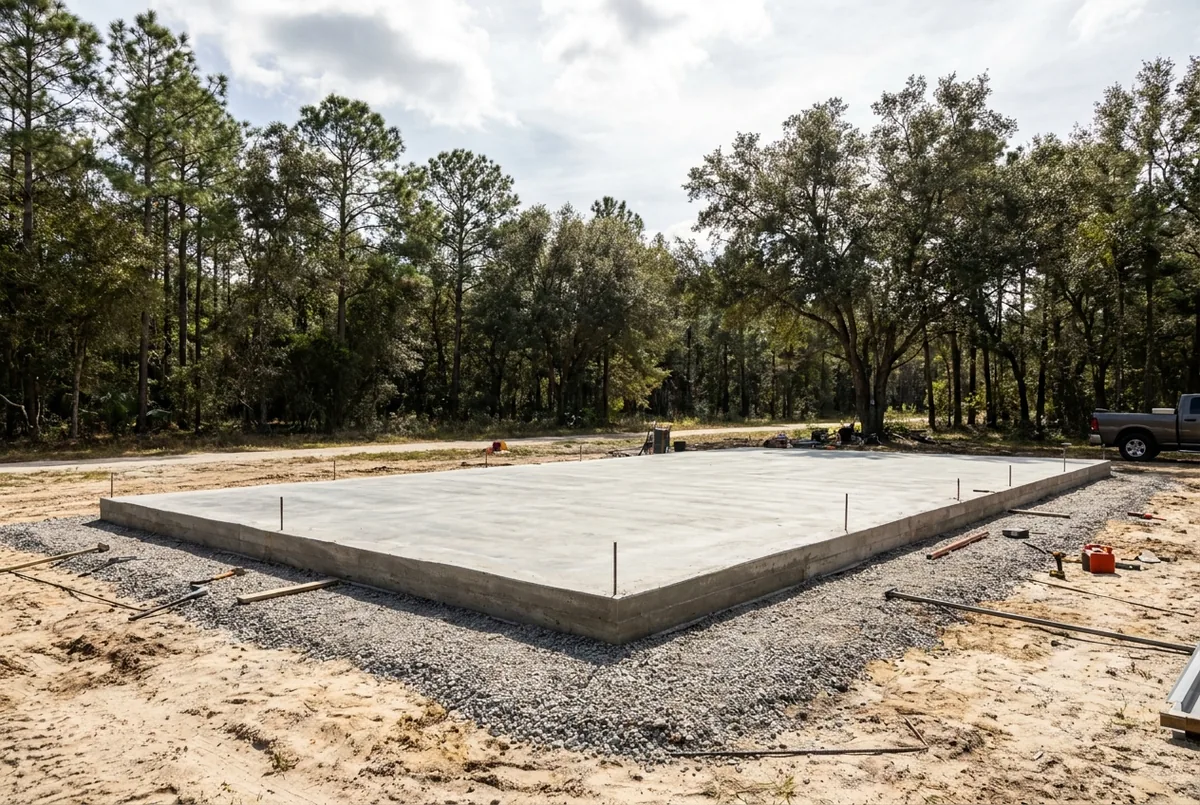
Most slab failures trace back to what's underneath. Every slab we pour starts with a properly compacted sub-base: we strip topsoil and organics, bring in and compact engineered fill where needed, grade for drainage, and compact in lifts to a stable, uniform bearing surface. Over that we lay a heavy polyethylene vapor barrier to block moisture migration up through the slab — critical in the region's high-water-table areas and essential under a barndominium's finished floors. Proper site grading directs water away from the building, and we account for the local soils, the climate, and any high water table on your specific lot.
Barndominium Slabs: Plumbing, Electrical & Finished-Floor Quality
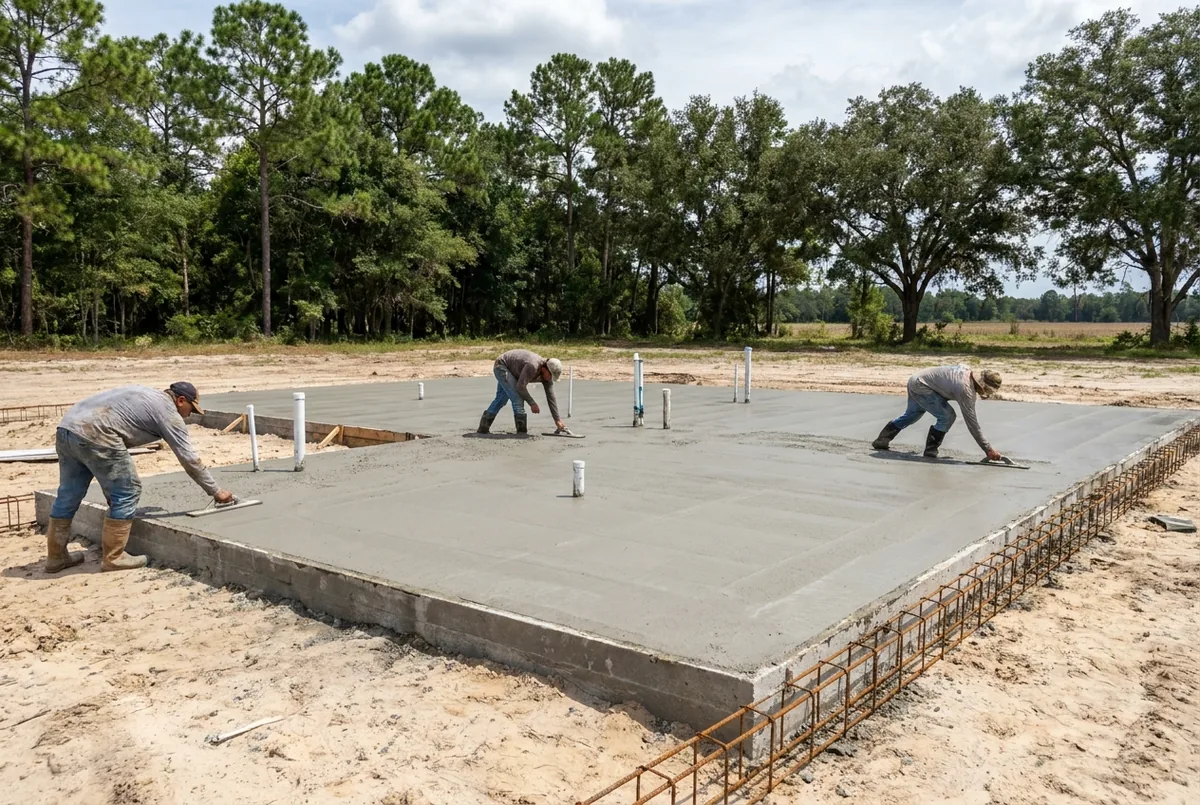
A barndominium is part workshop, part home — and the foundation has to serve both. Because the slab becomes the floor of finished living space, the rough-in work happens before the pour. We coordinate with your plumber and electrician so that under-slab plumbing, drain lines, and any electrical or conduit runs are stubbed up and inspected before concrete goes down. Load-bearing interior lines get thickened, reinforced footings beneath them. And because much of a barndominium floor ends up as finished or polished concrete or as the substrate for tile and flooring, we place and finish it to a higher flatness and surface standard than a bare shop pad — so your living areas start out level and clean.
Equipment Pads, RV Pads, Workshop & Shop Floors
Beyond full buildings, we pour the standalone slabs that keep a property working:
- Equipment pads for generators, HVAC units, grain bins, tanks, and heavy machinery — sized and reinforced for the point load.
- RV pads thick enough (typically 5 to 6 inches with rebar) to carry a loaded motorhome or fifth-wheel without cracking.
- Workshop and shop floors finished smooth and flat, with thickened areas under lifts and benches and optional control-joint layouts to manage cracking.
Whether it's a slab inside a pole barn or a freestanding pad next to it, we engineer for the load it'll actually carry.
Cost: What a Pole Barn or Barndominium Slab Runs
Pole barn and metal building slabs in the Port Orange area typically run $6 to $12 per square foot for a standard reinforced slab, and $10 to $16+ per square foot for thicker, heavily reinforced slabs, monolithic foundations with deep thickened edges, or barndominium foundations with under-slab plumbing and electrical rough-in. As project ranges, a typical 30x40 pole barn slab often lands around $8,000 to $18,000, and a larger or more complex barndominium foundation commonly runs $15,000 to $40,000+ depending on size and finish. The big cost drivers are: square footage, slab thickness, PSI and reinforcement, monolithic vs. footing-and-slab design, how much fill and compaction the site needs, plumbing/electrical rough-in for a barndominium, anchor-bolt and column-base layout complexity, and site access. The only honest way to price your project is to see it — call us for a free, written estimate.
Pole Barn & Barndominium Slabs Pricing in Port Orange
Transparent pricing for pole barn & barndominium slabs projects in the Port Orange area.
| Service | Price Per Sq Ft | Typical Project Cost |
|---|---|---|
| Pole Barn / Barndominium Slab | $5–$12 | $6,000–$40,000+ |
Prices reflect 2026 Port Orange, FL averages and may vary based on site conditions, access, thickness, finish, and project complexity. Contact us for an accurate, no-obligation quote for your specific project.
Other Concrete Services in Port Orange
Driveways & Sidewalks
Professional driveway installation, replacement, and resurfacing for Port Orange homes.
Learn More →Patios, Porches & Pool Decks
Custom patios, covered porches, and pool deck resurfacing across Port Orange.
Learn More →Slabs & Foundations
Concrete slabs, garage floors, pole barn pads, and foundations for residential and commercial.
Learn More →Stamped Concrete
Decorative stamped concrete driveways, patios, sidewalks, and pool decks.
Learn More →Pool Deck Contractors
Pool deck resurfacing, new installation, and repair throughout Port Orange and Volusia County.
Learn More →Sidewalk Contractors
Residential and commercial sidewalks, walkways, and ADA-compliant pathways.
Learn More →Retaining Walls
Structural and decorative retaining walls for erosion control and landscaping.
Learn More →Foundation Contractors
Residential and commercial foundations including slab-on-grade, crawl space, and pier foundations.
Learn More →Commercial Concrete
Commercial flatwork, parking lots, warehouse floors, ADA ramps, and loading docks.
Learn More →Pole Barn Barndominium Concrete Slabs by City
Local pole barn & barndominium slabs across Volusia County and the greater Volusia County area.
Pole Barn & Barndominium Slabs Projects
Recent pole barn & barndominium slabs work in the Port Orange area.
Frequently Asked Questions
How thick should a pole barn slab be?
Do you build the pole barn / building, or just the slab?
What does a barndominium slab or foundation cost?
Monolithic slab vs. floating slab — which is better for a metal building?
Do you pour equipment pads, RV pads, and workshop floors?
How do you handle anchor bolts and post placement?
Do I need a permit for a pole barn slab?
Ready for Your Pole Barn Slab Project?
Get a free estimate from Port Orange's trusted concrete professionals.
📞 Call (386) 220-8770 Request Quote Online